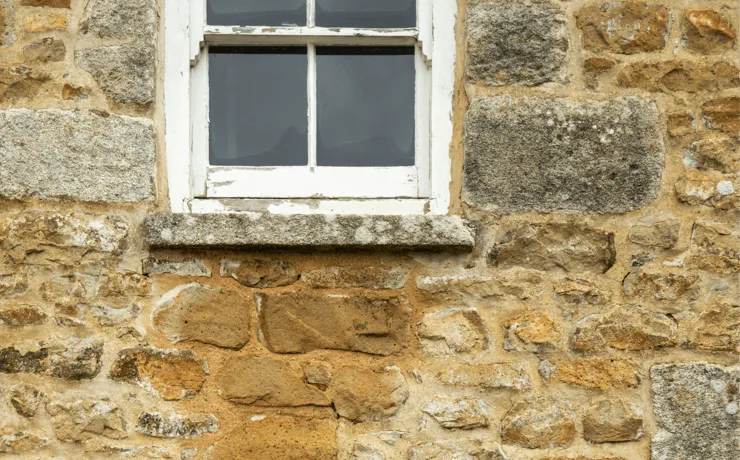
On a number of occasions, I’ve been called by homeowners who have seen alarming amounts of water running out from around the heads of their windows during heavy rain. The natural assumption is that there’s something wrong with the window itself, but sometimes the water has entered the wall much higher up and travelled down through gaps hidden within the stonework, before eventually finding somewhere to escape.
These gaps, known as voids, are not uncommon in traditional Cornish rubble stone walls. They can cause some surprisingly serious damp problems, even where the outside of the wall appears to be in reasonably good condition.
What are voids within a rubble stone wall?
Traditional Cornish rubble stone walls are generally built with two faces of stone, with smaller stones and clay mortar packed into the space between them. The stones themselves are also bedded in clay. Ideally, this forms a reasonably continuous mass, allowing moisture to move through the materials within the wall by capillary action and evaporate from its surfaces.
Voids are empty spaces within this construction, where mortar or packing material is missing. Some small gaps may have been present from the beginning, but more extensive voids can develop during the life of the building as mortar or packing material is lost. What makes them particularly troublesome is that the outer faces of the wall can appear perfectly sound, while the condition of the masonry behind them is very different.
For more information on how moisture normally moves through these walls, see our article on Liquid Moisture Movement in Clay and Stone Walls.
Why do voids develop?
There are several reasons why voids may be present within a rubble stone wall. Some may date from its original construction, where the core was not completely packed, while others develop as the building ages.
One possible cause is prolonged water penetration. Unlike lime mortar, clay mortar does not chemically set, and prolonged saturation can cause it to soften and become displaced. Defective gutters, flashings and other weather details can repeatedly direct large quantities of water onto particular areas of a wall. Over time, this may wash some of the clay and finer material out from between the stones, leaving gaps behind. This is particularly likely to be a concern where a building has spent many years in disrepair, although it can be difficult to establish whether particular voids were formed this way or were present from the outset.
Another cause I’ve encountered regularly is rat activity. Rats will burrow into the clay mortar within rubble stone walls, sometimes creating quite extensive networks of tunnels and nesting spaces. I’ve found rat nests within the cores of walls on numerous occasions, and the amount of material they can displace can be considerable. Movement within the masonry can also disturb the packing material, creating or enlarging existing gaps.
Find the Right Solution for Your Historic Building
Our four-step survey process begins with a no-obligation chat to see how we can best support your property and ensure you’re making the right choices.
What problems do voids cause?
In my experience, exposed rubble stone walls can be particularly vulnerable to problems associated with voids, especially where they’re pointed rather than protected by render or slate hanging. Although the pointing may appear reasonably sound, there may be very little mortar remaining behind it. Where the stones themselves are porous, this can make the problem considerably worse.
The first problem is that rainwater can penetrate through small gaps around the pointing and find its way into the wall core. Rather than being absorbed and redistributed through the clay mortar, the water can trickle down through connected voids under gravity. It may travel a considerable distance before encountering an obstruction, such as a window lintel, where it can collect and eventually emerge into the building.
The second problem is that missing mortar can make the wall less able to dry itself. Clay mortar contains fine, connected pores through which liquid moisture can move towards the wall surfaces and evaporate. Where significant amounts of mortar are missing, these pathways can become interrupted, making it more difficult for moisture deeper within the wall to escape.
This creates a double problem: water can find its way into and through the wall more readily, while the wall becomes less capable of drying itself. Where voiding is particularly extensive, the loss of internal packing may also affect the stability of the masonry, rather than simply causing dampness.
How can you tell whether your wall contains voids?
In my experience, one of the clearest indications of significant voids is the appearance of liquid water in unexpected places. Where rain penetrates a porous, exposed stone wall, the result is often fairly widespread patches of dampness on the internal surface. In a heavily voided wall, however, water can travel down through gaps in the core until it encounters an obstruction, such as a window lintel, before emerging around the opening. I’ve seen water trickling out around window heads in this way, sometimes quite dramatically.
Where walls have been dry-lined, the symptoms can be even more misleading. The lining may conceal much of the dampness, with water only becoming visible around windows, doors or other places where the lining is interrupted. However, water appearing around an opening doesn’t necessarily prove the presence of voids. Defective window detailing and other sources of rain penetration can produce similar symptoms.
Unfortunately, establishing whether a wall contains voids, and particularly how extensive they are, is difficult. The condition of the core of a rubble stone wall is rarely uniform. One area may contain significant cavities, while the masonry immediately alongside it remains reasonably well packed.
Careful opening-up or the use of a small inspection camera may reveal voids in a particular location, but there’s always the possibility of missing others nearby. More extensive investigations are possible, including specialist testing, but these can become prohibitively expensive. In many cases, it may simply not be practical to establish the full extent of voiding without undertaking considerable invasive work.
For this reason, it is often more useful to consider the symptoms alongside the building’s exposure, construction and maintenance history, rather than attempting to prove the presence of every void. However, where there are signs of structural movement, such as bulging or displaced masonry, further investigation may be necessary.
What can you do about voids?
Where voids are contributing to damp problems, the most practical approach is often to reduce the amount of water entering the wall in the first place. This means addressing defective rainwater goods, drainage and weather detailing, and ensuring that the external finish provides adequate protection against driving rain. On exposed elevations, pointing alone is often insufficient, particularly where the stones are porous. Suitable lime rendering or slate hanging can offer much better protection, provided the junctions and flashings are properly detailed to prevent water getting behind the finish.
It is sometimes possible to fill voids using suitable lime-based mortars or grouts, or by opening up sections of masonry and packing material back into the core. However, this can be extremely time-consuming and expensive, and there’s no guarantee of reaching every cavity. Any replacement mortar needs to be compatible with the original construction, both in strength and in how it handles moisture. Expanding foam is best avoided. Although it can stick to stone, it doesn’t restore the capillary pathways provided by traditional mortar, can restrict drying and is very difficult to remove once it has hardened.
An example from Cape Cornwall
I worked on a former agricultural building near Cape Cornwall where the walls were extremely exposed to the weather. The granite itself was very porous, and there had also been substantial rat activity over the years. Very little of the original bedding mortar remained behind parts of the exposed stonework. The wall had become almost a hollow structure, with loose stones rattling around inside it.
Filling the voids by grouting would have been extremely difficult, if not practically impossible. Instead, we worked across the wall section by section, carefully removing individual stones and packing mortar back into the construction as far as we could reach. We used NHL 2 based lime mortar, which was relatively soft and compatible with the masonry, but had enough hydraulic set to harden in the damp conditions we were dealing with.
It was slow work, and we had to accept that we would never be able to fill every cavity without substantially dismantling the wall.
This is often the reality of working with old rubble stone walls. Sometimes you can improve the condition of the masonry considerably, but there are limits to what can reasonably be achieved without causing further disturbance or incurring enormous expense. Where the wall is structurally stable, improving its protection from the weather may ultimately be more practical than trying to eliminate every void within it.
Need Expert Advice?
If you need expert advice on your building, our survey process is designed to be hassle-free. It all starts with a Free Introductory Call - a quick chat to discuss your property and see how we can help, with no initial obligation. Take the first step toward a drier, healthier home today.
Get Expert Advice