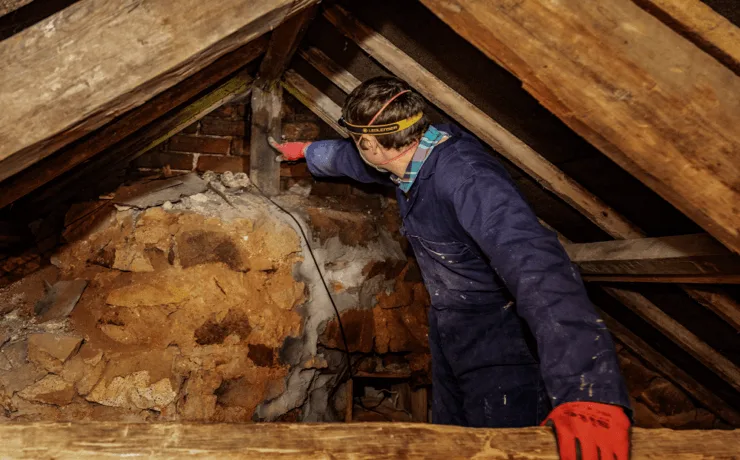
Dry lining is something I come across regularly in old Cornish buildings. Often it seems to be doing its job perfectly well, and I’ve no particular reason to think it is causing problems. But I’ve also been into rooms that smell damp, suffer from mould or never seem to warm up properly, even though the walls themselves look fine. Sometimes the problem is out of sight, behind the plasterboard.
Dry lining isn’t necessarily a bad thing. My concern is what happens when moisture begins getting into the stonework behind it. The normal warning signs may be hidden, sometimes for years, until the problem has become quite serious.
What is dry lining, and why is it used?
Dry lining involves creating a new internal wall surface, usually by fixing plasterboard, or occasionally timber cladding, to a framework of timber battens or studs. The framework sits in front of the original masonry, often leaving a cavity between the two. Insulation and membranes may also be incorporated into the construction.
It’s a common approach in older buildings, partly because it’s quicker and generally cheaper than applying a build-up of plaster. It provides a flat, regular surface and gives the opportunity to install insulation. However, I’ve also encountered plenty of examples where dry lining has been used to hide an existing damp problem. This is particularly common beneath chimneys that have been allowing water into the masonry, where the original plaster may have become badly damaged.
What happens when a traditional wall is dry lined?
Traditional stone walls are built from materials that can absorb moisture and redistribute it towards their surfaces, where it can evaporate. This is an important part of how they manage moisture. I’ve explained this in more detail in our article on Liquid Moisture Movement in Clay and Stone Walls.
My biggest concern with dry lining is that it hides the early warning signs of a problem. When a wall is plastered, moisture problems will often become visible through staining, deteriorating plaster or damaged paintwork, giving the homeowner a chance to investigate. Behind dry lining, however, these signs can remain hidden. The lining hasn’t necessarily caused the problem, but it may allow it to develop unnoticed for years. By the time the problem becomes apparent, considerable damage may already have occurred.
Dry lining restricts this drying process on the inside of the wall. Moisture can still evaporate from the original masonry, but it enters the space behind the lining rather than passing directly into the room. Even where vapour-permeable membranes are used, these don’t provide the continuous pathway for liquid water that traditional plaster finishes can offer. Once capillary movement is interrupted, the wall can only dry inwards by vapour transfer, which is much slower.
There is also the possibility of interstitial condensation, where water vapour condenses into liquid within the concealed construction. Moisture evaporating from the masonry, or humid air entering from the room, may condense on colder surfaces. Internal insulation can make the original stonework colder, increasing this risk.
Whether these changes to the wall’s moisture behaviour become a problem depends largely on how much moisture the original wall is having to deal with.

Find the Right Solution for Your Historic Building
Our four-step survey process begins with a no-obligation chat to see how we can best support your property and ensure you’re making the right choices.
Why are some dry-lined walls more vulnerable than others?
A particularly important consideration is the amount of moisture entering the original wall, sometimes referred to as its moisture load. A reasonably sheltered wall, with sound weather protection and little water getting into it, may cope perfectly well with dry lining. But a wall exposed to driving rain, or affected by defective gutters, drainage, chimneys or other weather details, may be a very different matter.
This is one reason why it’s difficult to give a blanket answer about whether dry lining is suitable for an old building. Much depends on the individual wall, its condition, how exposed it is and how effectively it’s protected from water penetration.
There’s another problem, though. Circumstances can change. A dry-lined wall might perform satisfactorily for twenty years, only for a gutter to become blocked, a chimney to deteriorate or some other defect to develop. Water can then begin entering the masonry in quantities that it struggles to release, and the homeowner may have no idea that anything has changed.
What are the risks, and how might you recognise them?
Where too much moisture accumulates behind dry lining, the original stonework can remain persistently damp. Wet masonry generally performs less well thermally, and the moisture can create conditions in which mould and fungal decay may develop. Meanwhile, the plasterboard covering the wall may continue to look fine.
When an old stone wall is plastered and is experiencing moisture issues, there are often visible clues. You might see staining, cracking or deteriorating plaster, salt deposits, or paint beginning to blister and flake. Behind dry lining, none of these are visible.
One of the more serious concerns is the condition of timbers built into the original masonry. Floor joist ends, lintels and other embedded timbers may still be sitting in the stone wall behind the lining. If moisture levels rise and stay high, these timbers can become vulnerable to fungal decay. Considerable damage can develop before anyone realises there’s a problem, sometimes to the point where structural repairs are necessary.
So what clues might suggest a hidden problem? In my experience, it’s often the conditions within the room itself. A persistent damp smell, mould that doesn’t have an obvious explanation, or a room that feels unusually cold and difficult to heat can all be clues. Increased movement or bounce in a timber floor may also be a concern, particularly if there’s reason to suspect that the supporting joists have become damp.
None of these things proves there’s a problem behind the lining. Poor ventilation, inadequate heating and other building defects can produce similar symptoms. Investigating the original wall may require removing parts of the lining, and even then, examining one area won’t necessarily tell you what’s happening elsewhere.
What can homeowners do to manage the risks?
When clients ask me about dry lining, I often explain that it comes down partly to their tolerance for risk. Some people are quite comfortable accepting the uncertainty that comes with concealing an old wall. Others would prefer a finish that allows the masonry to dry more freely and makes developing problems easier to spot.
If you’re considering installing dry lining, it’s worth understanding the condition of the original wall and the risks it is exposed to before covering it up. Is it exposed to prevailing wind and rain? Is the surrounding drainage adequate? Are there existing problems with gutters, chimneys or other weather details? All these factors influence how much moisture may enter the wall, and therefore how well it’s likely to cope with the reduced ability to dry.
But what if the dry lining is already there? It doesn’t automatically need to be removed. Whether removal is justified depends very much on the individual building and its condition. Stripping out several rooms and replacing the lining with traditional plaster can be enormously expensive, and where there are no significant concerns, keeping the existing system may be a perfectly reasonable decision. Again, understanding the risks the underlying wall is exposed to before making a decision is key.
What I do encourage is taking particular care of the building’s external weather protection. Gutters, downpipes, drainage, chimneys, flashings and other weather details need to be properly maintained and fit for purpose. The external wall finishes also need to provide adequate protection, particularly on exposed elevations. When a wall’s ability to dry towards the inside has been restricted, keeping excessive water out becomes especially important.
Old buildings rarely allow complete certainty. The usual approach is to read the symptoms together, weigh the wall’s exposure and history, and act on the most likely explanation. Where there are persistent damp smells, unexplained mould, evidence of water penetration or concerns about embedded timbers, further investigation is worthwhile. This may mean removing part or all of the lining to establish what’s going on. Where structural timbers may be affected, the consequences of leaving a problem unresolved can be considerable.
Dry lining doesn’t have to be a problem. If you’re going to live with it, keeping the original wall and its weather protection in good condition matters all the more.
Need Expert Advice?
If you need expert advice on your building, our survey process is designed to be hassle-free. It all starts with a Free Introductory Call - a quick chat to discuss your property and see how we can help, with no initial obligation. Take the first step toward a drier, healthier home today.
Get Expert Advice