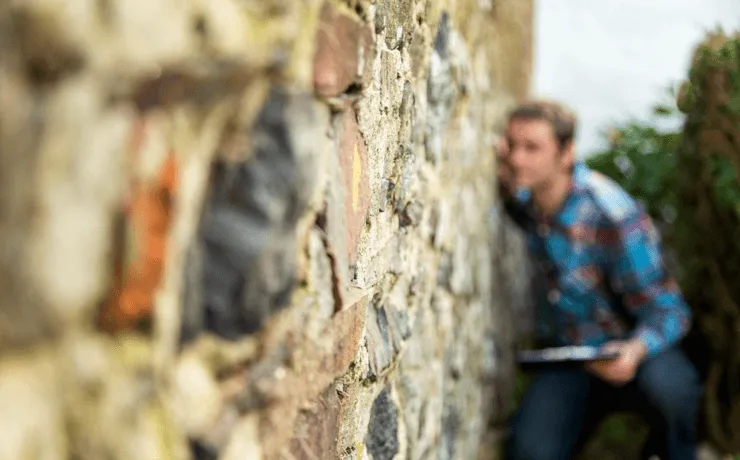
Traditional stone and cob walls are built to take up a certain amount of moisture and then release it again. This article looks at what is actually inside a solid Cornish wall, how liquid water and water vapour move through it, and what can stop a wall drying as it should.
What is inside a solid stone or cob wall?
Most traditional Cornish buildings constructed before 1900 have solid walls, built from stone and clay, or cob. In West Cornwall, rubble stone walling is particularly common due to the ready availability of stone.
A rubble stone wall has an inner and outer face of stone, generally with a clay based mortar filling the space between them and the core of the wall. The pointing visible on the surface was originally formed in lime; this is a much more weather resistant material than clay, but less readily available, so its use was often limited to where it was really needed.
In Cornwall, clay was readily available and required relatively little processing before use, though sometimes lime was added to improve its resistance to moisture. The arrangement of the stones provides much of the wall’s stability, while the clay mortar provides bedding and helps stabilise the masonry. It also plays an important part in how moisture moves through the wall.
Cob is formed from a mass of clay-rich subsoil, commonly mixed with straw to help reinforce it and limit cracking. Stones may be present, but they are largely incidental: the earth mixture itself forms the main body of the wall and carries its loads.
Cob walls almost always stand on a plinth of rubble stone masonry. This raises the earth construction above ground level and helps protect it from ground moisture and rainwater splashback. Cob can remain durable for centuries when properly protected, but prolonged wetting can soften and damage it. Both cob and clay-bedded stone walls contain porous clay materials, whose behaviour is central to understanding how these walls become wet and subsequently dry.
How does moisture move through the wall?
Unlike modern cavity walls, traditional solid stone and cob walls are constructed to accommodate a certain amount of moisture within their structure. Where a wall meets the ground, for example, some moisture uptake is almost inevitable. The important thing is that the wall can subsequently release this moisture through evaporation. Occasional wetting is not necessarily a problem, provided moisture does not accumulate faster than the wall can dry.
Moisture exists within a wall in two main forms: liquid water and water vapour. Both can move through the wall, but they do so in different ways. Liquid water can travel through the fine pores within clay mortar, cob and porous stones by a process known as capillary action. This is the same principle by which a wick draws up water.
Water vapour can also move through the pores within these materials by a process known as vapour diffusion. This allows moisture in its gaseous form to pass through the wall, although generally much more slowly than liquid water can travel through connected capillary pathways.
This difference is particularly important when a wall becomes wet. Capillary action can transport significant quantities of liquid water towards an evaporating surface. Where moisture has to rely on vapour diffusion to escape, the drying process is generally much slower.
I’ve seen this behaviour many times in practice. On one building in Camborne, we removed cement render to find the stone wall beneath running with moisture. Within a day, the exposed surface appeared almost completely dry. However, when we subsequently carried out repairs, we discovered that the core of the wall was still very wet. This illustrates how quickly the surface of a wall can dry while considerable moisture remains within it, and why maintaining conditions that allow moisture to continue moving towards an evaporating surface is so important.
The type of stone also influences how moisture moves through a rubble wall. Stones vary enormously in their porosity and capillary structure. In my experience, some granites readily absorb moisture through their weathered surfaces but have relatively poor capillary pathways for releasing it again. By contrast, more porous stones, such as many sandstones, can allow moisture to move both into and out of their structure much more readily. This is one reason why the type of stone needs to be considered when deciding how best to protect a wall from the weather.
A correctly functioning traditional wall can accommodate a certain amount of moisture and subsequently release it. Problems are more likely to develop where the wall is exposed to prolonged or excessive wetting, particularly when moisture enters faster than it can escape.

Find the Right Solution for Your Historic Building
Our four-step survey process begins with a no-obligation chat to see how we can best support your property and ensure you’re making the right choices.
How does a wet wall dry?
Clay mortar has an important quality: it can absorb and redistribute moisture within a wall. As moisture evaporates from the wall’s surface, connected pores within the clay allow liquid water from deeper inside the wall to move towards that surface, replacing the moisture being lost. Lime mortars also have this capacity, although to varying degrees depending on the particular mortar.
As a wall dries, the movement of liquid water through the mortar gradually slows. More of the remaining moisture must then escape as water vapour, which is a much slower process. Where mortar has been lost, leaving air spaces or voids within the wall, these can interrupt the movement of liquid water and make drying more difficult.
What can prevent a traditional wall from drying properly?
A wall’s ability to dry depends on more than just the materials it’s built from. There are three main things that can cause problems: unsuitable surface finishes, excessive wetting, and insufficient air movement.
The type of finish applied to a wall can have a considerable effect on its ability to dry. Dense cement renders, masonry paints and excessively strong hydraulic lime mortars can all restrict evaporation, preventing moisture from escaping freely through the wall’s surfaces. Over time, this can lead to a build-up of moisture within the structure.
Even a wall that dries effectively can become overloaded if too much water enters it. Defective gutters, poor drainage and failed weather detailing can all introduce more moisture than the wall can reasonably release. Where an exposed wall is not given sufficient protection by its external finish, driving rain can also penetrate the masonry and introduce excessive moisture into the wall core.
All other things being equal, air movement across the surface of a wall is generally the strongest driver of evaporation. Where external walls are sheltered by neighbouring buildings, trees or dense vegetation, reduced airflow can slow the drying process, even when the wall itself is otherwise in good condition.
What can you do about it?
Reduce the moisture load on the wall as far as possible. Gutters, downpipes, drains and weather details need to be not only well maintained, but properly designed and capable of handling the water they receive. External wall finishes also need to offer sufficient protection for the wall’s level of exposure. On an exposed elevation, repointing alone may not be enough to keep driving rain out, particularly where the stones are porous. A suitable lime render or slate hanging can offer much better protection, but only if the flashings, junctions and other weather details prevent water getting behind the finish.
Improve the ability of the wall to shed water. Lime mortars and renders are commonly specified for this purpose, but it’s important to recognise that different grades and mixes of lime vary considerably in how readily they allow moisture to move through them and evaporate. An interesting example is traditional Scottish harling, a roughcast lime finish whose textured surface provides a larger area for evaporation, while also helping to protect the wall from rain.
Air movement also plays an important part in drying. Cutting back or removing dense shrubs, trees and other vegetation that shelter a wall can help improve airflow across its surface, allowing moisture to evaporate more readily. While we can’t always change a wall’s surroundings, managing nearby vegetation can sometimes make a useful difference.
Traditional stone and cob walls can manage some moisture, but they need a balance between how much water enters and how readily it can escape. Keeping walls adequately protected from rain, while allowing them to dry, is usually more useful than trying to make them completely waterproof. The right approach depends on the wall’s materials, condition and exposure.
Need Expert Advice?
If you need expert advice on your building, our survey process is designed to be hassle-free. It all starts with a Free Introductory Call - a quick chat to discuss your property and see how we can help, with no initial obligation. Take the first step toward a drier, healthier home today.
Get Expert Advice