
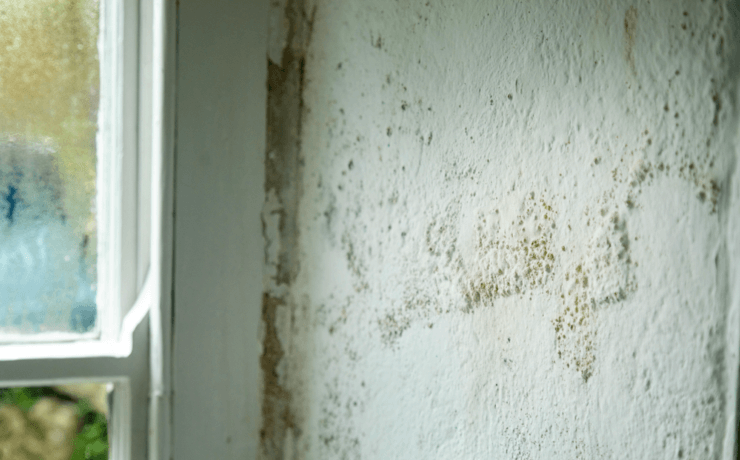
Damp in old buildings is rarely caused by a single defect. Traditional buildings work as complete systems, with drainage, weather protection, ventilation and breathable materials all interacting. This article explains why successful repairs begin with understanding the whole building rather than searching for a single cure.
Why are there no silver bullets?
One of the things I commonly encounter when talking to homeowners about damp in old buildings is the search for a single answer. They often come to me having been told that the render is at fault, that there is insufficient ventilation, that the building needs a damp-proof course or any number of other explanations. It is hardly surprising that people become confused, particularly when different specialists appear to offer opposing advice. Here in Cornwall, this often becomes even more confusing because traditional buildings vary enormously in their construction and exposure.
The conflicting advice is almost always given in good faith. Specialists naturally view buildings through the lens of their own experience and tend to place greater emphasis on the things they understand best. A lime specialist is likely to focus on finishes. A drainage contractor will naturally pay close attention to drainage. Somebody specialising in ventilation may be concerned primarily with humidity and airflow. Most genuinely believe in what they recommend.
Homeowners are not immune to this way of thinking either. Simple explanations are attractive because they offer certainty. There is something reassuring about believing that one problem has one cause and one solution. Unfortunately, old buildings are rarely that straightforward.
Damp problems are often the result of several factors acting together. A blocked gutter, high external ground levels and a modern impermeable finish may each contribute to the symptoms being experienced. Viewed in isolation, none of these issues may appear particularly significant. Together, however, they can upset the balance that allows the building to manage moisture successfully.
None of this means that advice from building professionals or contractors should be ignored, nor that particular products are inherently good or bad. Materials and interventions all have their place when used for the right purpose and in the appropriate circumstances. Difficulties tend to arise when one explanation or one remedy is expected to compensate for unrelated defects elsewhere in the building. Understanding the problem is more important than becoming attached to a particular solution.
Old buildings are not defective modern buildings
Old buildings are sometimes criticised for lacking the features we have come to expect in modern construction. Solid walls, the absence of damp-proof courses and relatively high maintenance requirements can all lead to the impression that they are somehow defective. In reality, they were built according to different principles and expected to function in a different way. This is particularly true of the granite, cob and rubble stone buildings found throughout Cornwall. Different does not necessarily mean worse.
One of the biggest differences is that old buildings do not rely upon excluding all moisture. Some moisture entering the structure of the wall is normal and was always expected. Rainwater, moisture vapour and humidity were managed by a combination of weather protection, evaporation and the ability of traditional materials to absorb and release moisture. In other words, old buildings were designed to manage moisture rather than eliminate it entirely.
Old buildings simply have different strengths and weaknesses. In my experience, one of the biggest differences is that they generally require more maintenance and are less tolerant of neglect, particularly where defects in roofs, gutters, chimneys or drainage are concerned. Traditional materials are often softer and more sacrificial than modern ones, but they are also easier to repair when problems do occur.
The buildings themselves have changed over time, but so have the expectations placed upon them. Most people expect their homes to be warm, comfortable and relatively maintenance free, which is entirely understandable. Problems can arise when modern expectations are imposed on buildings that were designed with different assumptions in mind.

Find the Right Solution for Your Historic Building
Our four-step survey process begins with a no-obligation chat to see how we can best support your property and ensure you’re making the right choices.
The three pillars work together
If we take a broad overview of the factors which help protect the outside of an old building, they can largely be divided into three general areas.
The first is the finish itself, whether that is render, pointing or plaster. The second is weather protection in the form of roofs, chimneys, gutters and other details which limit the amount of rainwater reaching the wall in the first place. The third is drainage, which helps prevent excessive moisture building up around the base of the structure. None of these areas works in isolation.
It is perhaps understandable that finishes receive so much attention. They are visible and, in the case of old buildings, discussions around lime have become particularly prominent in recent years. Yet a beautiful lime render cannot compensate indefinitely for an overflowing gutter, and perfect drainage will not make up for defects higher up the building. Equally, poor drainage may accelerate the deterioration of an otherwise perfectly good render. The three elements support one another, but defects in one can also hasten the failure of the others.
In practice, buildings can often limp along with weaknesses in one area, particularly if the other elements are performing well and the internal environment is reasonably stable. However, that balance is rarely maintained indefinitely. The longer one part of the system is relied upon to compensate for another, the more likely it is that symptoms will eventually begin to appear.
What do breathable materials actually do?
We hear the word "breathable" a great deal in the context of old buildings, but what does it actually mean? It is helpful to understand that the term, rather than being a precise scientific description, is a convenient way of describing a range of characteristics which affect the way materials deal with moisture. Fortunately, we do not need to understand all the chemistry and physics involved. It is enough to understand the effect these properties have on the building.
A simple way to give a rough illustration of the principle is to imagine two identical cubes, one made of lime mortar and the other of cement mortar. If both were saturated and left in the same conditions, the lime cube would dry more quickly. Put simply, lime is better at facilitating the movement of moisture. For those interested in the science, its pore size and distribution allow moisture to wick towards the surface by capillary action, and it is also much more effective at diffusing moisture from the surface into the surrounding air.
In order to function as they were intended, old walls rely upon a continuous pathway which allows moisture to move from the interior of the wall towards the surface where it can evaporate away. Some moisture entering the wall structure is normal. The important thing is that no more moisture is introduced to the wall than the wall is able to disperse.
Problems often arise when that pathway is interrupted. Applying a breathable paint over an impermeable render, for example, does not suddenly make the whole wall breathable again. Moisture management depends upon the continuity of the system rather than the properties of any one layer in isolation.
Finishes have two jobs. The first is to provide a degree of weather protection (particularly important in exposed coastal areas such as St Just and Perranuthnoe) and reduce the amount of water penetrating into the wall. The second is to help the wall shed moisture from its substrate by means of evaporation. It is the properties grouped together under the term "breathability" which assist with this second task.
It is also worth remembering that products can be described as breathable and still be unsuitable for use on old buildings. Microporous masonry paints and some paint-on waterproofing systems are technically vapour permeable and therefore legitimately marketed as breathable. However, they do not necessarily possess the wider range of characteristics which make traditional finishes so effective at managing moisture. Breathability on a tin or specification sheet does not automatically mean that a product is appropriate for a historic building.
Buildings are systems
One of the reasons damp problems can be difficult to understand is that no part of a building exists in isolation. Heating affects humidity. Ventilation affects temperature. Weather details influence the amount of water reaching the walls, while drainage influences the amount of moisture around their base. Changes in one area often have consequences elsewhere. In that sense, a building is better thought of as a system of interacting and interdependent elements rather than simply a collection of separate parts.
The occupants themselves are also part of that system. The way buildings are used has changed considerably over time. For example, houses which were once heated by open fires experienced significant air movement, whereas modern heating systems create very different conditions. People generally wash more frequently, cook differently and expect their homes to be warmer and less draughty than previous generations did. This means that the interaction between old buildings and their modern-day occupants is often very different from that which existed historically.
Defects often interact as well. A defect to a gutter or eaves detail may allow excessive water to reach a render. As the render deteriorates, more moisture may penetrate the wall. Increased moisture levels may then raise humidity within the building and create conditions favourable to timber decay. In many cases, what begins as one defect gradually develops into several interrelated problems. By the time symptoms become visible, the chain of events which produced them may have been developing for many years.
Materials are just materials
Damp problems are often frustrating because they are rarely simple. Faced with that uncertainty, it is only natural to gravitate towards simple explanations and simple remedies. People also have a habit of giving materials human characteristics. Cement becomes "bad", lime becomes "good", and concepts such as breathability can sometimes take on an almost messianic quality. In reality, materials possess physical and chemical characteristics rather than moral qualities. Their suitability depends upon the purpose for which they are being used and the circumstances in which they are being applied.
Most interventions have a place. Lime finishes, improved ventilation, drainage works, membranes and tanking systems can all be useful in the right circumstances. Some interventions may solve several problems at once through knock-on effects elsewhere in the building. None, however, can solve every problem. A material or technique which is entirely appropriate in one location may be wholly unsuitable in another. The most successful outcomes generally arise when remedies are chosen to suit the problem, rather than when problems are interpreted to suit a particular remedy.
The culture of maintenance
One of the biggest differences between old buildings and modern ones is that they require more maintenance. This is not a sign that they are defective. Regular maintenance was part of the design philosophy under which these buildings were constructed, and many of the materials used were intended to be repaired rather than replaced. Historically, there was much more of a culture of maintenance than exists today. Occupants often understood their buildings better and played a more active role in their upkeep. By contrast, modern buildings are generally designed with the aim of minimising maintenance, and modern occupants have naturally come to expect the same.
Maintenance should not simply be viewed as something which happens after defects appear. Good repairs and alterations should be designed with future maintenance in mind. For example, drainage systems and rainwater goods should be accessible and easy to monitor. Where gutters converge, hoppers can make blockages easier to deal with. Good detailing is not just about solving today's problems. It is also about making tomorrow's maintenance simpler and more effective.
Proactive maintenance is not an oxymoron. Small inspections and minor repairs often prevent much larger defects from developing. Gutters, roofs, weather details and drainage rarely attract much attention when they are functioning properly, yet neglect in these areas is responsible for many of the damp problems encountered in old buildings. Written maintenance schedules, however simple, can be surprisingly useful. The aim is not perfection, but to prevent small defects from accumulating into larger and more expensive problems.
There is no final state in which an old building becomes complete and no longer requires attention. Buildings change, their surroundings change and the way they are occupied changes. Living with an old building is therefore less about achieving perfection and more about understanding change and managing it sensibly. Regular maintenance not only helps prevent defects from developing, but also helps occupants develop a deeper understanding of the building itself. In time, that understanding often becomes one of the most valuable tools available when making decisions about repairs and alterations.
Need Expert Advice?
If you need expert advice on your building, our survey process is designed to be hassle-free. It all starts with a Free Introductory Call - a quick chat to discuss your property and see how we can help, with no initial obligation. Take the first step toward a drier, healthier home today.
Get Expert Advice